

Written by Stefan van der Berg
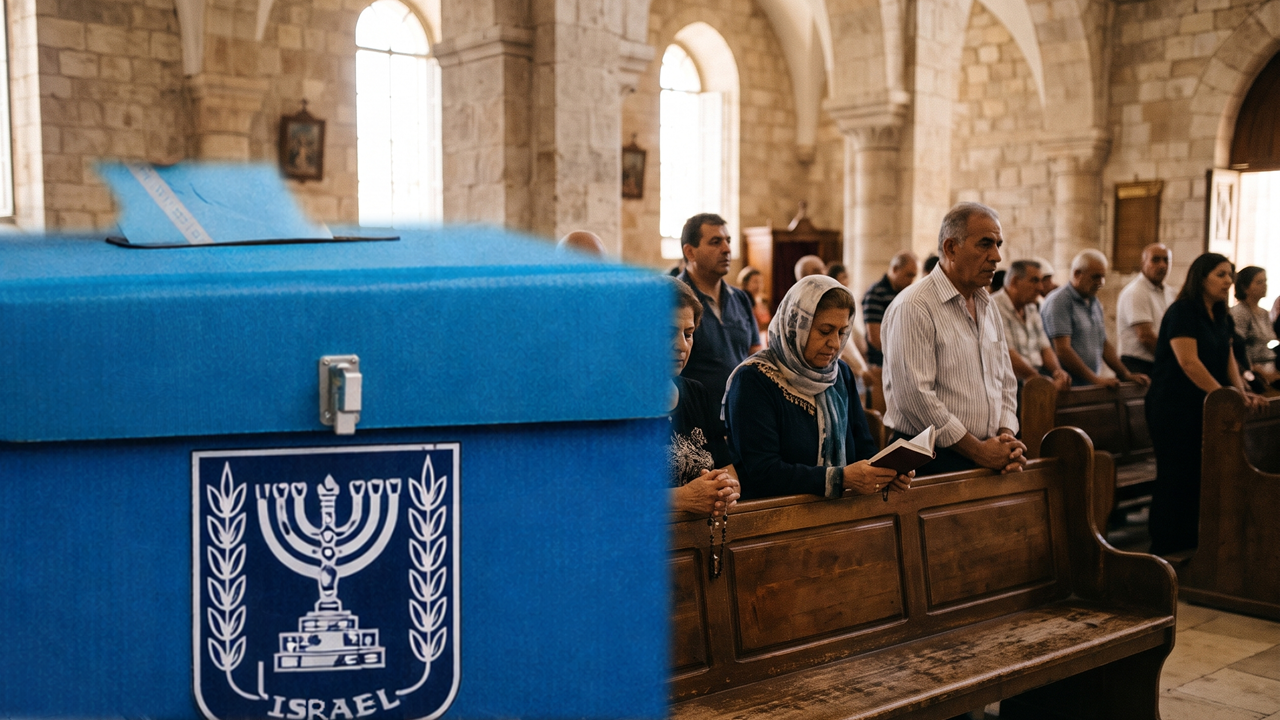
On Tuesday, 27 October 2026, Israel goes to the polls. All eyes are on the politicians. But I don't want to write about politics today. I want to write about people. I want to write about the Church.
Let me take you back a year.
I was on a research trip through Israel, the West Bank and Gaza. For security reasons I couldn't enter Gaza itself. But a friend from Gaza, who now lives in the West Bank, speaks to the church there daily. Through him I was able to talk on WhatsApp with the small group of Christians still inside.
I expected anger. I expected bitterness. I expected them to ask: where is God?
What I heard instead was gratitude, courage and compassion. Compassion for their own families, and for their Muslim neighbours who had also lost their homes. Empty hands, but open hearts.
Before the war there were about a thousand Christians in Gaza. Today only a few hundred remain. Some managed to get out. Others died. But many are choosing to stay, and their reason is simple: this is our home.
This is Israel's first national election since the attacks of 7 October 2023. For Jewish Israelis that is far more than a date. Almost every family knows someone who was affected, and they go to the polls with that wound still open. In Gaza, in the war that followed, nearly eight out of every ten buildings have been damaged or reduced to rubble. Ordinary families who had nothing to do with that day now shelter in tents. Their priorities are water for today, food for tomorrow and a roof for the night.
Our travels have taught me one thing: pain is not a competition. A mother in Israel and a mother in Gaza weep with the same grief. We don't have to decide whose tears count. We only have to be human enough to see both.
Then there is the ballot box. Many of the Christians I work with cannot vote in this election. People in Gaza and the West Bank, and most Palestinians in East Jerusalem, do not vote for Israel's parliament, the Knesset. They carry the heaviest burden, with the least say.
Picture it this way. If Israel were a class of fifty children, only one of them would be a Christian. One in fifty. Like a single lamp in a house: small, but it gives light to everyone inside.
The Christians in Israel are two branches of the same tree: Jewish believers, often called Messianic Jews, and Arab Christians.
Messianic Jews believe that Jesus is the Messiah. There are an estimated ten to twenty thousand of them. They speak Hebrew, and they are Israeli citizens. Yet they live between two worlds. To many Israelis, a Jew who believes in Jesus has betrayed his own people. For some the cost is high: a family that turns its back on you, a community that treats you as an outcast, a job that is suddenly gone. Many keep a low profile. And still, almost unnoticed, their congregations are growing.
The second branch are the Arab Christians. They make up most of the Christian population in the country, with roots that go back to the very first church. They are a minority within a minority: Arab among Jews, Christian among Muslims.
So what is life like for these believers?
Inside Israel, Christians can worship freely. In the West Bank and Gaza, many believers come under pressure from more than one side. But freedom on paper and ease on the street are not always the same thing.
Last year the Rossing Center in Jerusalem recorded forty percent more incidents against Christians and churches than the year before. A friend's father, an Arab Christian in Israel, was spat on in the street. In a culture where honour and shame weigh so heavily, that is no small thing. A family carries that kind of humiliation for years.
In fairness, it is a small extremist fringe that approves of acts like these. Senior Israeli leaders and the chief rabbi have openly condemned such actions.
In the West Bank there are more than 900 checkpoints, gates and roadblocks, which Israel says are needed for security. There I met a new believer who time and again couldn't get to his weekly Bible study. Not because his faith was too small, but because the checkpoint was closed, or he was turned away without explanation. Again. For someone new in the faith, losing that fellowship week after week takes a real toll.
And what about the next generation?
Recently two young men from the region came to visit us here in South Africa. One is an Arab citizen of Israel; the other comes from the West Bank. They spoke about fear, and about leaving.
Christians there have long been the middle class: teachers, nurses, business people. When life becomes too hard, the middle class doesn't start a revolution. They leave.
The greatest danger to the Church in the Holy Land is not one dramatic day. It is one family at a time, packing up and leaving.
Yet that is not the whole story. In every town I visited there are families who stay. Who raise their children there. Who keep the church doors open.
Many of our readers love Israel. I share that love. After everything the Jewish people have endured historically, their safety should matter to every believer. The same goes for the families in Gaza and the West Bank.
Standing with Israel, and standing with the Christians and their Muslim neighbours in that region, are not two opposing camps. When I acknowledge the pain of one, I am not choosing a side. I am choosing people.
And these Christians are not only victims. They are peacemakers. In the Christian hospital in Nazareth, a Jewish mother and an Arab mother sit side by side in the waiting room. Israel's own parliament has honoured the hospital as a bridge between the two communities. There, loving your neighbour is not only preached. It is lived out every day.
Justice is for everyone, or it isn't justice.
Which brings me back to those WhatsApp conversations with Gaza. Not one of them was about politics. They were about neighbours. Politics draws borders. Love crosses them.
Governments come and go. But the same Jesus who was born, died and rose again in that land still has a people there today, Hebrew-speaking and Arabic-speaking.
The question is not only who will govern them after this week. The question is: what will you and I do today?
We can pray.
We can go and visit, not only Israel but also our brothers and sisters in the West Bank. And we can look across the border to Gaza, and weep.
So that the remnant in the Holy Land does not become a museum of our past, but remains the heartbeat of its future.
Please pray with us:
- For a peaceful election, and wisdom for whoever governs. For the families still mourning 7 October and the war that followed, and that Jews, Arabs and Christians can live safely side by side.
- For both branches of the Church, the Messianic believers and the Arab Christians: courage to stay, and unity with one another.
- For the young Christians thinking of leaving, that they will see a future in their own land.