

Tuxedos on the Floor: Finding Our Shared Humanity in the Washington Hilton Chaos
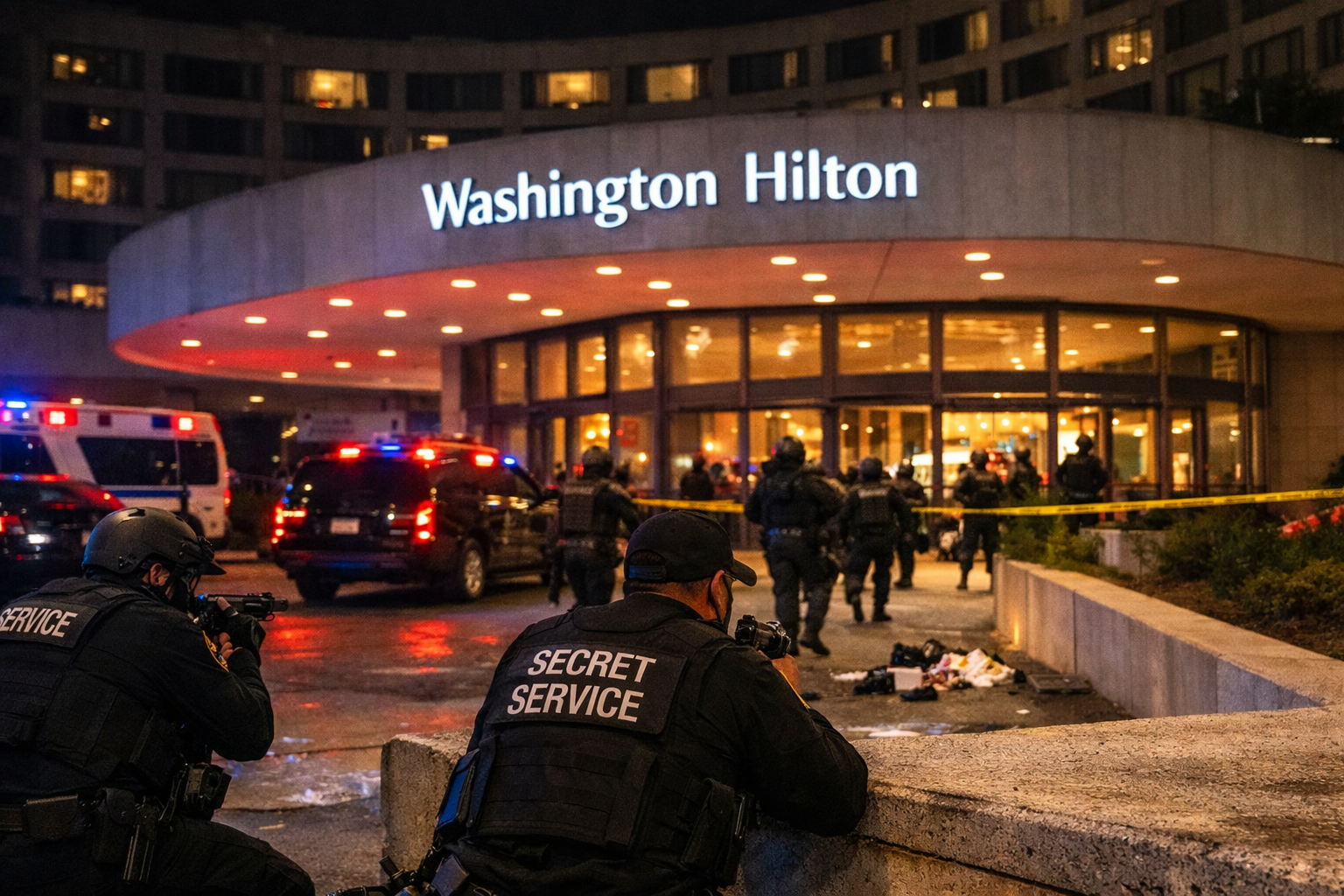
Gunshots once again rattled the Washington Hilton last night. President Donald Trump and First Lady Melania Trump are reportedly unharmed after seven to eight shots disrupted the annual White House Correspondents’ Dinner—an evening of high-society tradition that quickly descended into a scene of historical terror.
To understand the stunned silence currently hanging over Washington, one must remember the Hilton’s walls. This is the same hotel where, forty-five years ago, John Hinckley Jr. stepped from a crowd and shot President Ronald Reagan as he reached for his limousine. That singular image forever linked the hotel to a dark corner of American history. Last night, those ghosts returned.
The Scene of the Crisis
The White House Correspondents’ Association (WHCA) has existed since 1914 as a bastion of press freedom, ensuring transparency between the administration and the public. Its annual dinner—attended by presidents since 1924—is usually a night of satire, lighthearted jabs, and scholarships for the next generation of journalists. It is a critical link between the government and a free press.
Last night, that link was severed by violence.
The alleged shooter has been identified as Cole Tomas Allen, a 31-year-old from Torrance, California. A high-achiever on paper, Allen graduated from Cal Tech with an engineering degree in 2017 and recently completed a master’s degree in computer science in 2025.
Armed with firearms and knives, Allen reportedly stormed the Hilton lobby. Inside the underground ballroom, the elite of Washington dived under tables as shots rang out nearby. One law enforcement officer was struck in his bulletproof vest; he is expected to recover. As the Secret Service evacuated the President, Vice President JD Vance, and Cabinet members Marco Rubio and Pete Hegseth, the gravity of the moment was magnified by a nation already on edge, currently at war with Iran.
The Dual Lens: Justice and Brokenness
In the immediate aftermath, the rhetoric was swift. The Acting Attorney General labeled the suspect a "coward," while President Trump described him as a "sick person."
Here lies a tension that speaks directly to the Christian perspective. Justice demands accountability—the law must address the deed. However, faith reminds us that violence almost always erupts from a broken soul convinced that destruction is a solution.
The Great Equalizer
There is a powerful, sobering image from last night: a President and a waiter, both forced to the floor at the same time.
When the Secret Service screams, “Get down!”, all hierarchy vanishes. In that sudden, terrifying moment, there is no distinction between a billionaire president, an elite journalist, and the waiter clearing the plates. Everyone is equal in their fear; everyone is equal in their fragility.
From a Christian worldview, this is a visceral reminder of the Imago Dei—the truth that we are all equally fragile and equally precious. Violence does not discriminate between the powerful and the powerless. It strips away the tuxedos and the political titles, forcing us to acknowledge that underneath the surface, we are simply human beings who need one another to survive.
Beyond the Thin Veneer
We spend our lives building walls—visible and invisible. We hide behind our homes, our cars, and our digital screens. We allow titles and bank statements to define our worth, but those are merely a thin veneer. A single crisis—a disease, a disaster, or chaos in a Washington hotel—scrapes that veneer away to reveal that we are all made of the same dust.
The application for us today is simple but challenging: Practice seeing the "invisible" people in your daily life. Whether it is the security guard, the shelf-packer, or the technician, greet them with the same dignity you would accord your most important client. If we truly believe that all are equal before God, we must prove it in the quiet, mundane moments, not just in our grand rhetoric.
If we recognize our equality in the shadow of death and fear, why do we struggle so hard to elevate ourselves above one another in the light of life?