
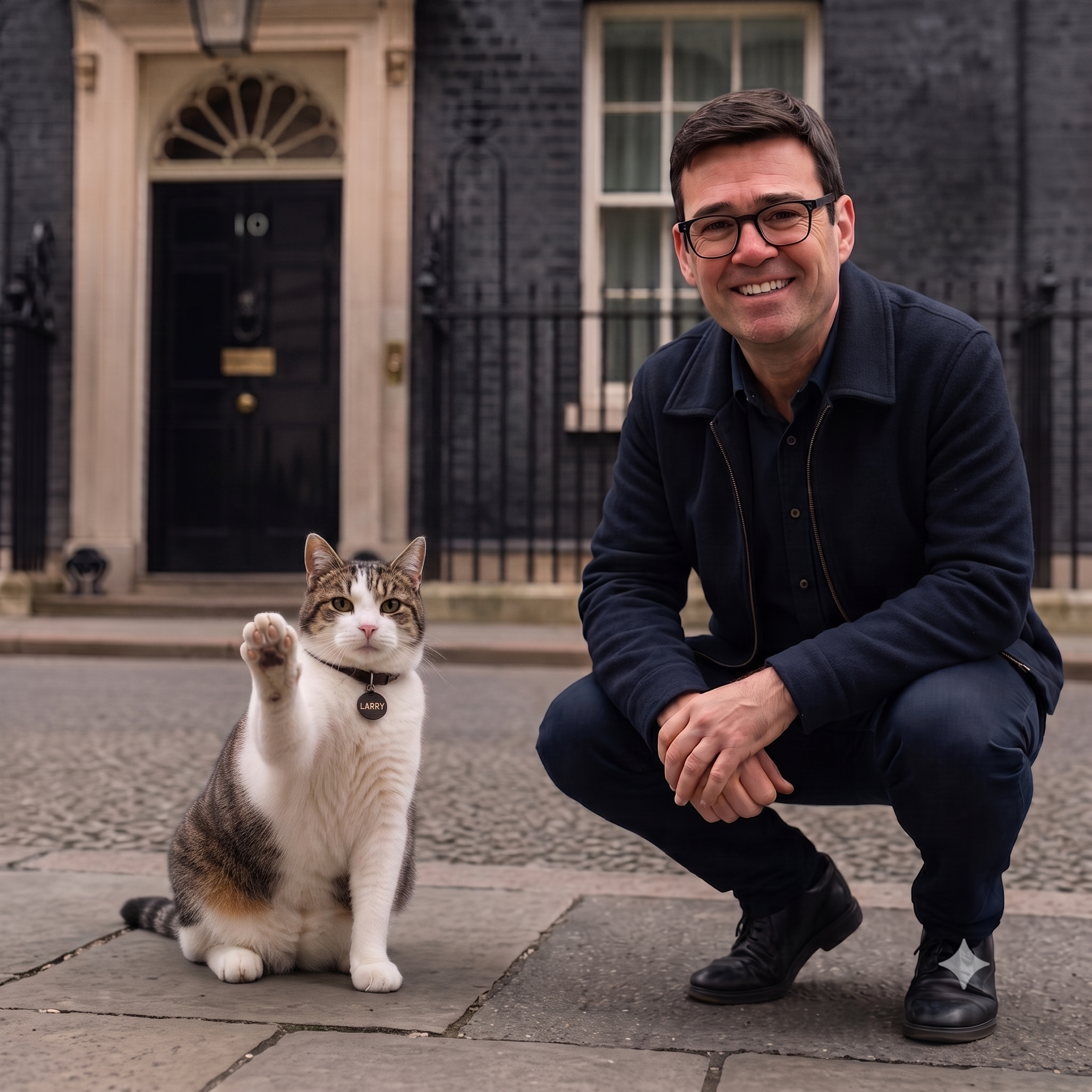

Larry, officially the Chief Mouser to the Cabinet Office at 10 Downing Street, has outlasted six British Prime Ministers. This morning, he meets his seventh.
By lunchtime today, Sir Keir Starmer travels to Buckingham Palace to formally resign to His Majesty the King, who will then invite Andy Burnham to take his place. No general election. No public vote. Just a change of Labour Party leader, and with it, a change of government.
If that sounds strange coming from South Africa, it should. In South Africa, a new president means an election. In Britain, whoever leads the party with a majority in Parliament gets the keys to Downing Street automatically. The public doesn’t get a say until the next scheduled election, whenever that ends up being.
Starmer led Labour to a landslide win less than two years ago. That should have bought him time. It didn’t. Pressure built up over the economy, immigration, and a scandal tied to Britain’s former ambassador in Washington. Last month Starmer announced he was stepping down. He said his own party had started questioning whether he was the right man for the job, and that he accepted that “with good grace.”
The moment he said he was going, the field narrowed quickly. Andy Burnham, the former Mayor of Greater Manchester, had already won his way back into Parliament and was the clear frontrunner from day one. By Friday it was official. Burnham won the leadership unopposed, with nearly all of Labour’s MPs behind him.
Burnham isn’t walking into an easy situation. Three problems stand out above the rest.
The first is welfare, and specifically disability benefits. Britain spends over £322 billion a year on welfare, more than a fifth of government spending, according to Treasury figures. A recent government review concluded the disability support system is “no longer fit for purpose.” Burnham has ruled out touching pensions, but he’s been sharply critical of earlier proposed cuts to disability payments, calling them “the wrong choice” that could cause “significant harm” to people who genuinely need help. He’ll have to fix a broken system without breaking the people who depend on it, or the budget.
Then there’s defence spending. Like most of Europe, Britain is under pressure, largely from NATO and worries about Russia, to spend more on its military. The target is 3.5% of national income by 2035. Burnham has signed off on a plan to spend roughly £298 billion on defence over the next four years, but nobody has fully explained where that extra money comes from yet.
Then tax. Burnham has promised not to raise income tax, national insurance, or VAT, the three biggest sources of government revenue. At the same time, he’s admitted there’s “some room” to move elsewhere, and he’s floated the idea of making large out‑of‑town retailers pay higher business rates. Economists are watching closely. Promising to spend more while refusing to touch the main taxes tends to prove difficult to sustain.
Britain is still one of the biggest economies on earth, a major NATO power, and a country tied to South Africa through history, trade, and the Commonwealth in ways that still matter to many people here. What happens in Westminster around defence budgets and trade policy doesn’t stay in Westminster.
There’s a quieter shift happening underneath all of this, one you might miss entirely if you’re only watching the politics. In the 2021 census, only 46% of people in England and Wales said they identified with Christianity, down from 72% two decades earlier. Over the same stretch, the share of Britons who tick “no religion” climbed from 15% to 37%. For the first time in recorded history, fewer Britons identify as Christian than as having no religion.
Burnham fits that story more closely than you might expect. He was sworn in as an MP on a Bible, but he’s been open that he isn’t sure God exists. He was raised Catholic and has said the Church “made me who I am,” yet he drifted from it over its stance on sexual orientation issues, a tension he’s called “fairly hurtful” in his own relationships. In that sense, Burnham stands roughly where the average Brit stands today: shaped by Christianity, no longer quite inside it. Maybe that’s the real story underneath the numbers — not that Britain lost its faith exactly, but that so much of it, like Burnham, hasn’t quite managed to let go either.
Pray for wisdom and steadiness for Britain’s new leadership. Ask that Andy Burnham, as he takes office, will be guided to make decisions that protect the vulnerable, steward resources wisely, and seek peace in a time of global tension.
Pray for renewal of faith across Britain. As census numbers show a nation drifting from its Christian roots, pray that the gospel will continue to shape lives quietly beneath the surface, and that many will rediscover the hope and truth of Christ in their own generation.
Larry the cat, meanwhile, won’t be at any ceremony today. He’ll be doing what he always does: patrolling the halls, ignoring whoever’s in charge, waiting for the mice. Six prime ministers taught him that much.