

Written by Stefan van der Berg
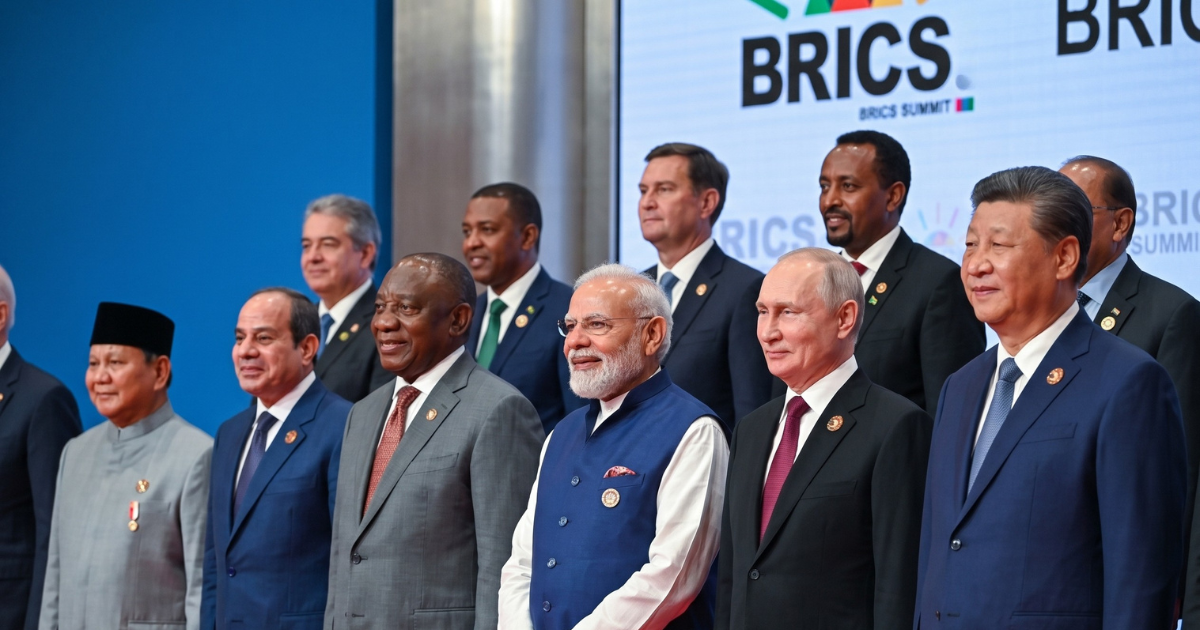
Last week, leaders from eleven of the world's largest emerging economies gathered in New Delhi and adopted a 140-paragraph statement on everything from artificial intelligence to Gaza. Most coverage read it as an economic story, a bloc flexing its muscle against the G7. But look again, and the New Delhi Declaration is something else too: a snapshot of where the unreached world actually lives.
A Bloc That Keeps Growing
BRICS isn't the five-country club it used to be. Since 2024, Egypt, Ethiopia, Iran and the UAE have joined as full members; Indonesia followed in January 2025; and after two years of sitting on the fence, Saudi Arabia formally joined in July 2025. Argentina, invited alongside them, walked away from its own invitation. Ten more countries, including Nigeria, Vietnam and Malaysia, now hold official "partner" status, a formal on-ramp to future membership.
The result: eleven full members representing roughly 48% of the people alive on Earth today, not far off one in every two of us, and a share of global GDP now closing in on the G7's.
The Overlap No One's Talking About
Here's what the economic headlines miss. Cross-reference this year's BRICS membership against Open Doors' 2026 World Watch List, the annual ranking of the fifty hardest places on Earth to follow Christ, and six of the eleven full members show up on it: India, China, Iran, Saudi Arabia, Egypt and Ethiopia.
That's not a coincidence of geography. It's a signal that as BRICS grows, it isn't just consolidating economic and political power — it's consolidating a huge share of the world's least-reached people under governments that make following Jesus costly.
India alone, the summit's host this year, is home to well over a billion people living in what missiologists call "unreached" people groups — communities with no indigenous, resourced church able to reach them without outside help. That single country holds more unreached people than the entire population of most continents.
What This Means for the Church
Political blocs like BRICS grow by pooling resources and building interdependent partnerships rather than working in isolation. That's precisely what a 140-paragraph joint declaration represents.
The global Church has historically done missions the opposite way: a wealthy sender nation, a receiving field, a one-directional flow of money and workers.
That model is no longer sufficient for a mission field this size. What's needed looks more like what BRICS itself practises: partnership between equals. Believers in Brazil and Nigeria and South Africa linked directly to believers in the hardest corners of India, China and Iran; churches "twinned" with churches, each side both giving and receiving, neither cast permanently as the benefactor. It breaks the old one-way script and lets the whole body of Christ, including those in the very nations on the World Watch List, carry equal weight in reaching the unreached.
BRICS didn't set out to draw a map of the world's spiritual need, but it has, almost by accident, drawn one anyway. Six of its eleven members are among the most dangerous places on Earth to carry a Bible, and nearly half the planet now lives inside this bloc's borders.
The BRICS bloc is a mission field we can't afford to ignore — and this year's summit only made that clearer.