

The War Within: Perception vs. Reality in Israel
Perhaps it is time for Israel’s supporters in the West to face a difficult truth: more Arab citizens volunteer to defend Israel in the IDF than Ultra‑Orthodox Jews do.
This, even though Arabs are often painted as "the enemy of Israel" and Orthodox Jews celebrated as “the people of God.” This irony in Israel today is striking. Those whom many Christians defend as “the people of God,” and who see themselves as the guardians of ancient covenantal faithfulness, Torah observance, and separation from secular society, now stand at the center of a crisis that threatens to destabilize the very thing they aim to defend: ISRAEL.
The ultra‑Orthodox Haredi community is not only shaping Israel’s internal political landscape — it is driving what may become the most consequential domestic conflict in decades. What is unfolding inside Israel’s borders may ultimately prove more destabilizing than anything posed by Hamas, Hezbollah, or Iran. The war that matters most right now for Israel is the one raging within. And, ironically, the uncritical support of Western Christians may be adding fuel to the fire.
A Military in Crisis
The Israel Defense Forces (IDF) are fighting a prolonged, multi‑front war with too few soldiers, rising exhaustion, and declining confidence in the political system’s ability to address the crisis.
Israel has been involved in at least six extensive conflicts in the past five years. These conflicts overlap and reinforce each other, creating the most complex regional security environment Israel has faced in decades. During these conflicts Israel suffered the impact of wars that was high in intensity, long in time and emotionally draining for all involved.
The IDF is a mid‑sized military with a very large reserve force — totaling about 634,500 personnel across all branches. There are about 175,000 personnel on active‑duty, and 450,000 reserves, leaving a current shortage of about 10,000–12,000 soldiers. And the gap is widening. Years of continuous operations and heavy reserve call‑ups have pushed both regular and reserve forces to breaking point. Some reservists now serve 80–100 days a year, far beyond normal expectations.
The human cost is becoming unbearable: IDF suicides have more than tripled in the past five years, with the steepest rise beginning after 7 October 2023.
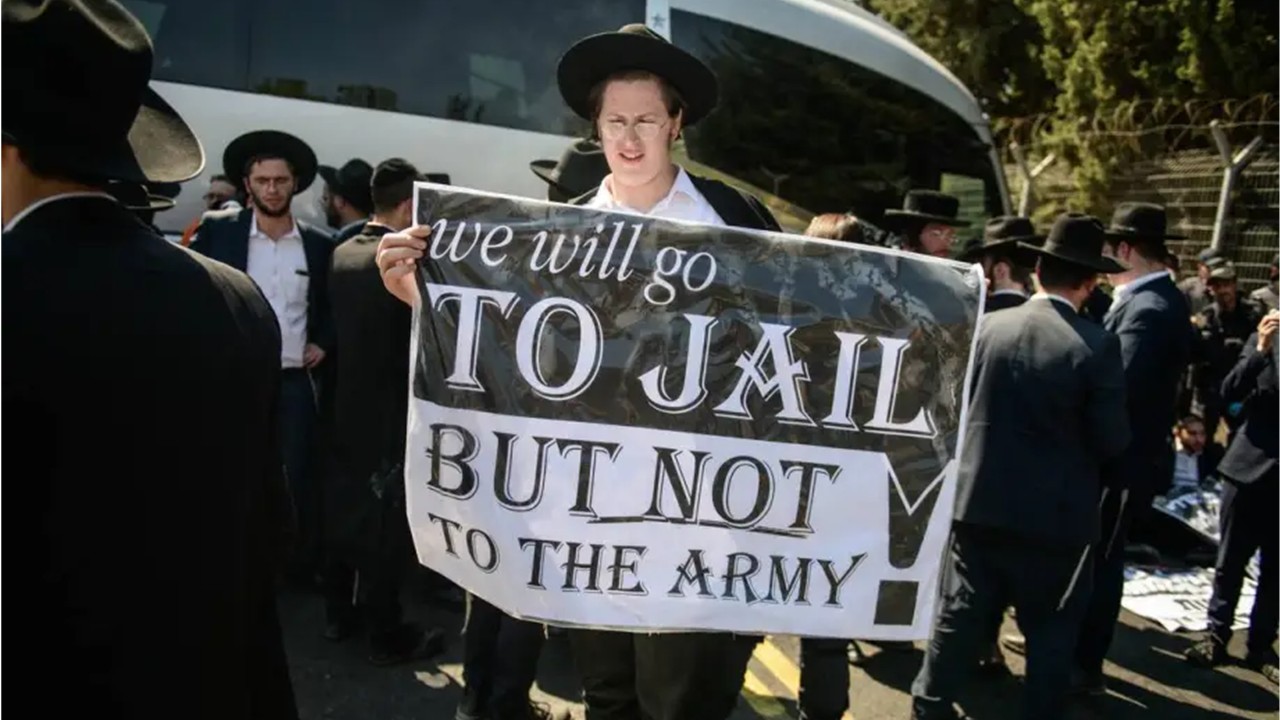
In response, the IDF issued 24,000 draft notices to the Ultra-Orthodox community to step up and defend the nation they call home. Only 1,200 responded — about 5%.
A Political System Under Strain
By May 2026, Israel’s ruling coalition began to fracture as ultra‑Orthodox parties demanded a permanent exemption from military service. One major Haredi faction publicly declared it had “lost faith” in Prime Minister Netanyahu and called for dissolving the government — a move that accelerated the push toward early elections.
Earlier, in February 2026, mass Haredi anti‑draft protests shut down major highways near Bnei Brak after a draft‑evading yeshiva student was detained. The High Court warned that enforcement must increase, especially during wartime. The draft issue is no longer a social debate — it is a matter of national security.
A Theological Paradox for Western Christians
Many American Christians passionately defend the ultra‑Orthodox community as the most “authentic” expression of biblical Judaism. Yet the Haredim are the least engaged in defending the modern State of Israel, with the lowest enlistment rates in the IDF.
Meanwhile, the people who do defend Israel — secular Jews, Druze, Bedouin, Ethiopian Jews, Russian Jews, and Religious Zionist Jews — rarely appear in Western Christian narratives about Israel.
The paradox deepens: far more Arab Israelis serve in the IDF than Haredim, even though Arab service is voluntary and Haredi service is legally expected but widely avoided.
- Arab Israelis in the IDF: ~4,500–6,000
- Haredi new enlistments per year: ~3,300
- Active Haredi soldiers: significantly fewer
This reveals an uncomfortable truth: Our loyalties are often shaped more by theology and imagination than by reality.
Who Are the Haredim?
Israel is home to roughly 1.45 million Haredi Jews, about 14–15% of the population. Their demographic profile is extraordinary: 57% are under age 20, and the average fertility rate is 6.5 children per woman — one of the highest in the developed world.
Where Do the Haredim Live?
Haredi communities are concentrated in a handful of major centers:
- Jerusalem: 22.6% of all Haredim
- Bnei Brak: 16%
- Beit Shemesh, Modi’in Illit, Beitar Illit, Elad: ~25% combined
These cities form a dense network of ultra‑Orthodox life, culture, and religious authority.
What Do the Haredim Believe?
At the heart of Haredi life is a single, animating conviction: to devote one’s entire existence to Torah — studying it, preserving it, and shaping every aspect of life around it.
Their worldview holds that unceasing Torah study and strict observance sustain the Jewish people and protect the world.
Yet this creates a painful contradiction: the very beliefs that define Haredi identity also prevent many from participating in the defense of the nation they inhabit. Their safety depends on the protection provided by those outside their community.
Haredim and Christianity
Many Western Christians honor Haredim as God’s chosen people who must be defended at all costs. But the sentiment is not mutual.
Haredi Judaism views Christianity as avodah zarah — foreign worship — for Jews, and in some interpretations, for Gentiles as well. To preserve Jewish identity and halakhic boundaries, Haredi communities teach distance from Christian theology. They completely reject Christian claims about Jesus.
For Haredim, Jesus is:
- A Jewish man from history
- Not the Son of God
- Not a prophet (as Muslims believe)
- Not the Messiah
- And certainly not divine
They avoid Christian symbols and worship because Jewish law prohibits participation in non‑Jewish religious rites.
In Summary
Israel’s greatest internal crisis today is not external enemies but the unresolved tension between a rapidly growing ultra‑Orthodox population and a military and political system struggling to sustain itself.
The Haredim see themselves as the guardians of ancient faith. The IDF sees them as the missing soldiers needed for national survival. Western Christians often see them as the most “biblical” Jews. And Arab Israelis — often overlooked — are serving in greater numbers than the Haredim themselves.
The gap between perception and reality has never been wider.
```