
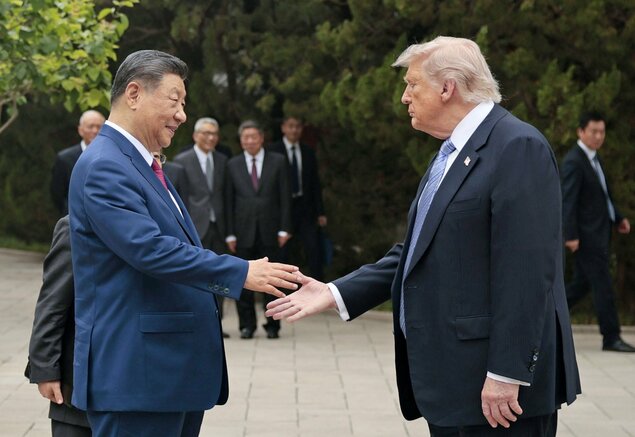

Donald Trump arrived in Beijing on Wednesday morning, 13 May 2026, beginning a highly choreographed state visit that Chinese officials hoped will reset relations between the world’s two most powerful nations. He departed on Friday afternoon, 15 May, after two days of ceremonies, talks, and symbolic gestures designed to project stability amid global tensions.
The Porcelain Divide
Tea ritual meets cola culture as two leaders stage diplomacy in symbols.
In the polished pavilions of China’s Zhongnanhai, diplomacy is staged not only in words but in cups. President Xi Jinping’s invitation to Donald Trump for a tea ceremony is more than refreshment; it is a performance of continuity, a civilization stretching back millennia.
The Chinese tea ceremony embodies harmony, respect, and balance. In diplomatic settings, offering tea is a gesture of cultural authenticity and sincerity—a way of reducing distance and signaling that dialogue is grounded in tradition as well as politics.
For Trump, the trademark Diet Coke remains his drink of choice. The contrast is deliberate: a carbonated symbol of modern consumerism set against porcelain ritual. The optics of this “tea-and-cola” diplomacy matter as much as the conversation itself. In Beijing, every sip is a signal.
Diplomacy in the Shadow of Hormuz
Energy dependence collides with sovereignty disputes as the summit falters.
The summit’s substance has been dominated by the Middle East. Trump insists on preventing Tehran from acquiring nuclear weapons. He is blunt about leverage: the United States no longer views the Strait of Hormuz as vital. China, by contrast, remains deeply dependent on these oil flows.
Yet, beneath the jasmine-scented courtyards, the real friction lies in the "third rail" of regional politics: Taiwan. Xi has warned that mishandling the island’s status could steer the two powers into “highly dangerous waters.” The message to Washington is clear: while energy and trade may be negotiable, sovereignty is not.
The Architecture of Patience
Ancient tactics confront Western deal-making urgency.
To Western eyes, the deadlock appears like failed communication. To seasoned observers, it reflects an older maneuver. Sun Tzu—the 5th-century BCE Chinese strategist—authored The Art of War, a 13-chapter manuscript on strategy written to guide rulers in minimizing the costs of prolonged conflict.
His central claim was that “the supreme art of war is to subdue the enemy without fighting,” a principle that elevates positioning and intelligence above brute force. Analysts suggest Xi is applying this logic: framing China as a peace advocate in Iran while quietly securing energy interests. Where Washington seeks a signed deal, Beijing seeks a favorable landscape.
The Integrity Deficit
Strategic ambiguity and populist contradictions erode trust in global diplomacy.
Beneath the clash of styles lies a deeper crisis: credibility. The East leans on calibrated ambiguity; the West on populist contradictions. What is missing is radical integrity—the principle that a superpower’s word should mean what it says. In a world of shifting mirrors, the casualty is often truth itself. When the Art of War meets the Art of the Deal, agreements are written in sand and promises become placeholders.
A Thin Bridge of Oil
Fragile accords span mistrust, leaving stability as volatile as the markets.
The summit may end with a fragile energy accord—a “thin bridge of oil” spanning mistrust. But the divide remains: a civilization playing for centuries against an administration playing for the moment. If common ground is only transactional, stability will be as volatile as the markets it seeks to calm.
For those living in the crossfire of great power games—from Gaza’s families to Hormuz’s sailors—the most revolutionary promise is honesty. A Yes that remains Yes, a No that remains No—this is the bridge that ordinary people can walk across.
As the Gospel reminds us in Matthew 5:37, “Let your ‘Yes’ be ‘Yes,’ and your ‘No,’ ‘No.’” In a world of strategic shadows, such clarity is not naïve—it is radical integrity, and perhaps the most enduring form of power.