
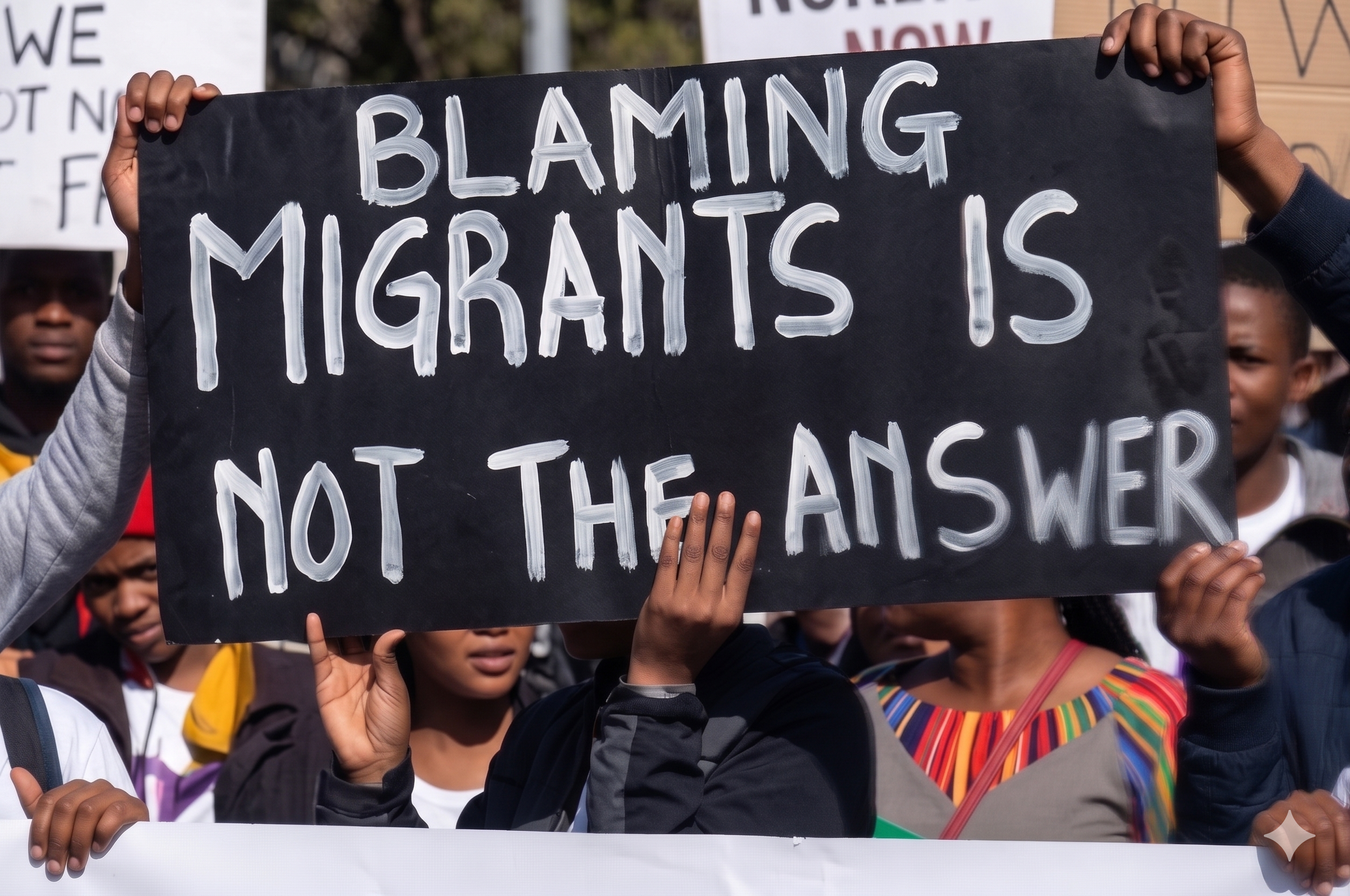

An economy is not only about money. It never was. It is a record of what a society values, what it protects, and what it is willing to destroy. Right now the violence aimed at foreign migrants is destroying more than we realise.
I write this as one of the 85.3% of South Africans who call themselves Christian, so this is not a finger pointed outward. It is a mirror held up.
Xenophobia is hostility toward foreigners. Afrophobia is something more specific, the violent rejection of fellow Africans. That distinction matters, because what is happening in South Africa is not a generalised anxiety about outsiders. It is targeted hostility toward people who share our continent and our history, people who, the moment they are attacked, remind us that they share our humanity.
Here is the economic reality. A company like MTN serves more than 307 million customers across Africa, the first African company past the three hundred million mark. Standard Bank operates in twenty African countries beyond our borders and earns 40% of its profit there. Sanlam, through its SanlamAllianz venture, serves more than 30 million customers across two dozen African countries. Much of that growth rests on African consumers choosing South African brands when they have other options. Every customer is a vote of continental confidence, and we are destroying it one violent episode at a time. The hidden economics of Afrophobia are not complicated. The people we chase out of our townships are the same Africans our biggest companies are banking on for growth.
People do not migrate toward failure. They migrate toward opportunity. If Johannesburg were a country, by one analysis it would be the richest state on the African mainland per capita. Foreign nationals make up 3.9% of the population (Census 2022). Migrants did not create the country’s 32.7% unemployment rate, and directing violence at them does not lower it by a single point.
The anger underneath is real. Rising food and transport costs, deliberate incitement, and communities under genuine strain. Organised movements like Operation Dudula (Zulu for "force out") and March and March now press a 30 June deadline for undocumented migrants to leave. The violence that follows does not check papers. It checks accents.
None of this means the law should go unenforced. A state unable to control its border struggles to protect anyone within it. But undocumented status is, first, a failure of the system, an immigration process that takes years, border controls that fall short. That failure harms both sides. South Africans left unsure who is among them, the migrant left without papers or recourse, which is exactly what makes him vulnerable. Mend the channel and you serve everyone in it. A riot is not a border post.
This is not hypothetical. In September 2019, xenophobic violence in Johannesburg forced MTN to close its stores in Nigeria, and its share price came under pressure. In 2026 the pattern repeats. Mozambique says it has buried five citizens killed here. In the scramble before the 30 June deadline, more than 8,000 foreign nationals were processed for repatriation at the Beitbridge border in under two weeks, while neighbouring states arranged flights to fly their citizens home. Travel warnings are being issued against South Africa.
The economics play out at every level. My wife and I know a domestic worker, a documented immigrant, and a single mother raising a handicapped child. Last week an employer told her not to come back, out of fear his property might be targeted in retaliation. She lost income she cannot replace. He lost nothing but his courage. That is how Afrophobia operates: sometimes with a machete, sometimes with a phone call. The same logic runs through the roadside vegetable stall. Foreign nationals sell produce at prices no supermarket can match, stretching the budgets of the poorest. Burn them out, and prices rise.
Since 2008, Xenowatch has recorded at least 612 deaths, 122,000 people displaced, and over 6,300 shops looted or damaged, and it warns these are almost certainly undercounts. Many of those shops sit in buildings owned by South Africans, who lose the rent when those shops burn. Afrophobia is not protecting South Africa's poor. It is taxing them.
Every figure so far has been counted in rands. But there were always two currencies. Fear and Grace. Afrophobia has us paying in the wrong one. Fear feels cheap at the till. A phone call, a match, a vote costs you almost nothing in the moment. The bill comes later, and it comes to the poor first, the broken confidence, the repatriation flights, the prices that rise the day you drive the trader out. Worse, it is the kind of money that buys less each time you spend it, more suspicion required for the same hollow promise of safety that never quite arrives.
Christ traded in the other currency. Not scarcity and suspicion, but the stranger welcomed, the outsider dignified, the hungry fed. It costs more to spend, and it is the only one that holds its worth.
In the census figures, 85.3% of South Africans call themselves Christian. The census counts the claim, not the practice. This is what the practice would look like. Asked who counts as a neighbour, Jesus answered, a despised foreigner, the Samaritan who stopped on the road, and named him the one who showed mercy. The gospel does not say tolerate the stranger. It says love him as yourself. A genuinely Christian economy does not ask whether the Malawian or the Zimbabwean deserves to be here, it asks what we owe each other as image-bearers of the same God, and then it spends what it was given.
The poor cannot afford our fear. Neither, it turns out, can the rest of the country.