

Written by Richard Baird (Church and Culture Consultant dia-LOGOS)
I’ve recently had the privilege of visiting Egypt with a small group of friends. What started out as an idealistic church/youth group trip morphed into something much smaller and incredibly special. It was a group of 8, a mix of young people and adults, and comprising of Christians (one of which was a former missionary in Egypt) and two self-confessed agnostic/atheists (two incredibly beautiful people from whom I learnt so much). What a marvellous group! Each person spoke of the trip as being incredibly impactful on their lives. One young person put it like this: “It was incredible to be immersed in a new culture and learn about their history. I will forever cherish the bonds I built on the trip with our hosts as well as the rest of our group.”
The itinerary was full and intense, and before I went, I realised that a theme had emerged in the itinerary: sacred spaces. We were visiting temples and tombs, pyramids and churches, a mosque, a rural village in the Nile, as well as the grand library of Alexandria and catacombs, and of course the newly opened Grand Egyptian Museum. Each place had special sacred significance in its own way in the sense of encountering the transcendent in some form.
But before I get into the trip, a little bit about Egypt’s current reality. In terms of Christianity, 80% of Christians in the Middle East live in Egypt. If Saudi Arabia is regarded as the heart of Islam, then Egypt is the head. This is the intellectual centre of Islam, as well as the birthplace of many of the more extremist Islamic groups (such as the Muslim Brotherhood). It has experienced much upheaval as recent history shows (Arab Spring). Currently, under the Presidency of Abdel Fattah el-Sisi (since 2014), my experience of ‘grassroots level living’ is that there seems to be a collective relief that the revolutions are over, and I daresay a very cautious optimism that things can get better. Like most people everywhere, people just want to be able to get on with life. It seems that the policies and infrastructure that Sisi has implemented has put Egypt onto the right trajectory economically. Certainly things are better politically for Christians. There seems to be a revolution happening of a different sort, a quieter one in which many Coptic Christians are shifting towards being more evangelical in their faith identity. But I do not want to over-romanticise things either. Persecution and suffering remain a reality for Christians, especially in the more rural areas of Upper Egypt, and the economic disparity is, as in so many countries, great. Our host informed us of the reality of quite a few millionaires and even billionaires, but the majority of the population still live below the poverty line. Tourism is a life-line for many.
And our tour was special.
As we journeyed together as a group, exploring the variety of places
under the theme of sacred spaces, there was much conversation and a tapestry of
themes emerged even further: what defined a sacred space? What was home?
The idea of ‘home- home’ emerged as one of the team spoke about the realities of many who experience displacement from their home and have to work elsewhere for the sake of earning a living. This conversation arose in the context of visiting our host’s home village where he grew up. For those experiencing displacement in their new environment, it’s difficult to fully express one’s cultural identity because one feels very much a fish out of water. They’ve sought to make a home in their new environment, but it simply isn’t their true home or ‘home-home’ Such people will lead their lives but when it comes to significant rites of passage they go to their ‘home-home.’ This really spoke to me and had such Biblical resonance as well as I thought about how we make this earth our home, but it’s easy to forget that heaven is our ‘home-home.’ It’s also a powerful reminder of how, for example the Israel-Gaza conflict, has at its root the notion of land and identity. We all want to live in our ‘home-home.’
Another theme, based on my opportunity to preach twice, was my message entitled ‘A Meal in the Wilderness’ and the text was Hosea 2:14. The message was an imaginative reconstruction of a meal hosted by Jesus to us in the wilderness. The wilderness is normally a place of testing and training, but in this verse it was a place of undeserved tenderness, because God’s people were deserving of divorce and punishment, but God was still going to remain faithful and was expressing desire. I imagined a conversation taking place and Jesus saying three things during the course of the conversation: You are not forgotten, You are Treasured and Let me Love you. The Wilderness is indeed a sacred space as well, and this entire trip represented a meal in the wilderness as we encountered such love and hospitality. As my daughter put it: it wasn’t just visiting all the amazing historical sites that made the trip special, but the in-betweens as well: the conversations in the bus, the laughter around the meals, the debriefing discussions held each evening. It all contributed to creating a sacred space. Hearing Psalm 91 read aloud in the context of Cairo traffic was especially significant and meaningful!
A special highlight was how each person had the opportunity to share a reflection or thought for the day. The insights that came through were incredible. One young lady began her reflection by stating the following: “Egypt is not a good place to be a Christian, but it’s a good place to become a good Christian.” Each morning brought a special insight or challenge: such as the call to be joyful with gratitude not only for our own sake but also for the sake of others that they may be blessed through it. We were encouraged by another to consider the theme of the afterlife since the ancient Egyptians were experts in contemplating and preparing for this, and that perhaps we too need to learn to measure time in centuries and recognise that our lives are indeed short. From the time the Pharaoh’s came into power, they prepared their tombs, inspecting on average three times a month. All tombs remain unfinished because they did not know when their time would come.
Experiencing all these sacred spaces brought home to me the reality of how God has set eternity in the hearts of men (Ecclesiastes 3:11). Looking at the hieroglyphs, seeing the temples, seeing familiar Biblical parallels reminded me with fresh appreciation how the Bible reveals a story within a story within a story. The first story is what we read on the words of Scripture, how God called a people and how they were continuously disobedient until we reach the New Testament where we encounter the miracle that despite all the history we read in the Old Testament, there exists a fully systematized system of Judaism into which Jesus the Jew was born. But that storyline exists within a broader cultural reality: Moses grew up in Pharoah’s court and experienced all the trappings involved and would have been taught all the worship rituals and gods. This gave him a point of reference when God gave him instructions. The Tabernacle, for example, with the outer court, inner court and Holy of Holies would not have been unusual for him, because the Karnak temple at Luxor follows the same pattern. The Ark of the Covenant was not unusual because Egyptian worship had their equivalent too. I imagine God saying: “You’ve seen these things, but this is how you are to do it properly in order to worship Me, the One True God.” Remember too how Israel got attacked and its citizens deported to foreign lands such as Babylon with a whole different religious outlook on life. The third-level story is that all of these exist within the context of God’s sovereignty, where He oversees all of history. Ancient Egypt existed under His eye – Cyrus of Persia was called God’s servant (Isaiah 44:28). And all these levels come together incarnationally in Jesus where the Sovereign Lord through whom all things are made (John 1:1-3; Colossians 1:15-20) becomes a Jewish man raised within Judaism within the context of Roman oppression and who dies to save us from the consequence of our disease of sinful rebellion against God (Luke 4:18-19; Romans 9:4-5; 1 Cor 1:20-25; Phil 2:5-11). Let’s also not forget how Egypt was part of the upbringing of Jesus as a toddler, residing as a refugee, and there are various stations throughout Egypt where oral tradition holds that the family resided for short periods and which we managed to see some. Remembering these three levels of story or context will help us to not become myopic in reading the narrative of Scripture.
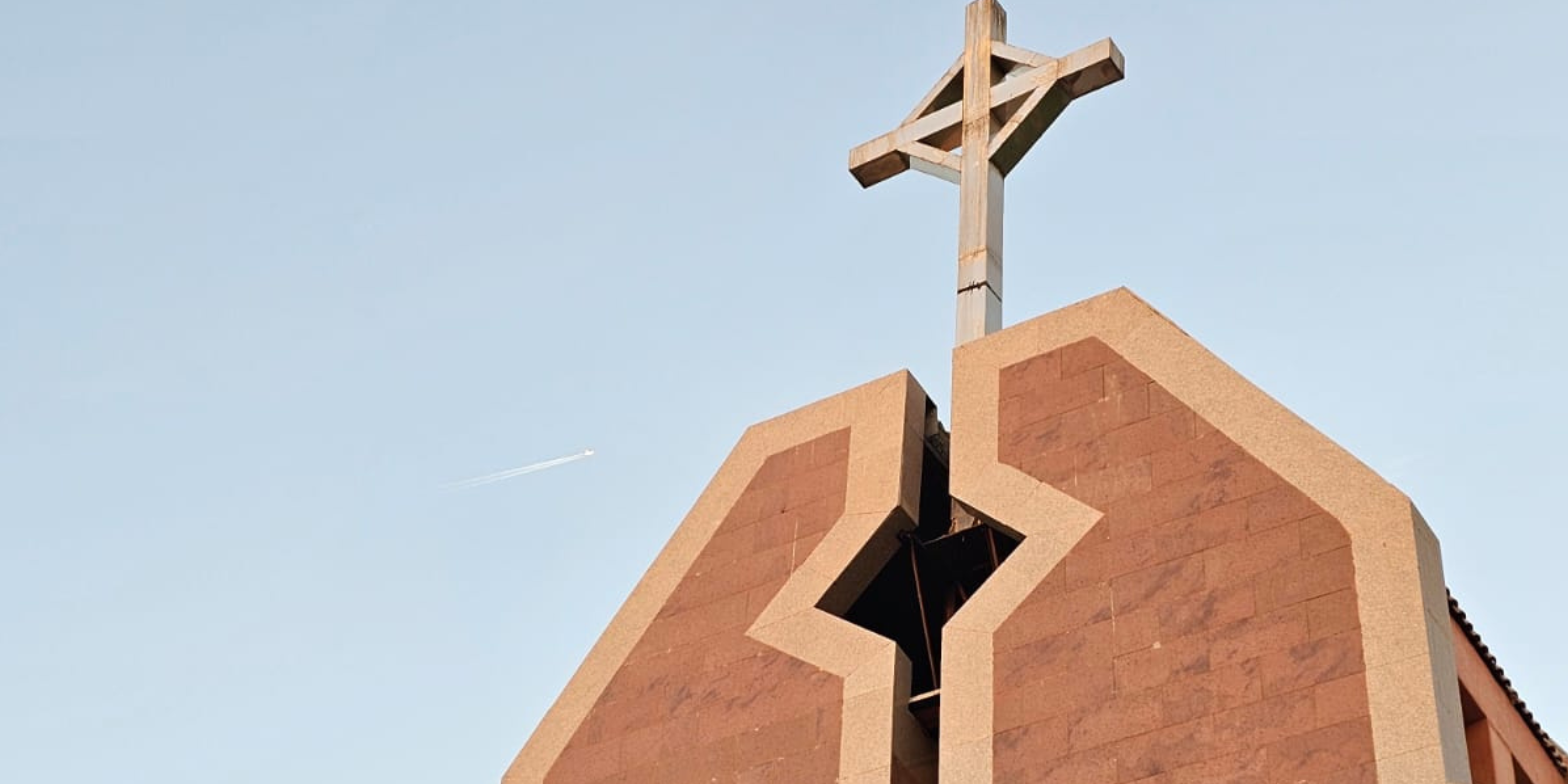
It was incredible to encounter the Church of the Martyrs, commemorating the 21 Christians who died on the Libyan beach. Egypt has a rich history of gifting the church with martyrs. And never in my wildest dreams did I think I would be singing “Joy to the World” in the heart of Cairo in a community church with representation from many nations at a Nativity play presentation featuring a live donkey and camels, with some good humour injected too.
But wait…there’s more.
My final thought I want to elaborate further in a separate
article reflecting on the past year from a church and culture perspective.