
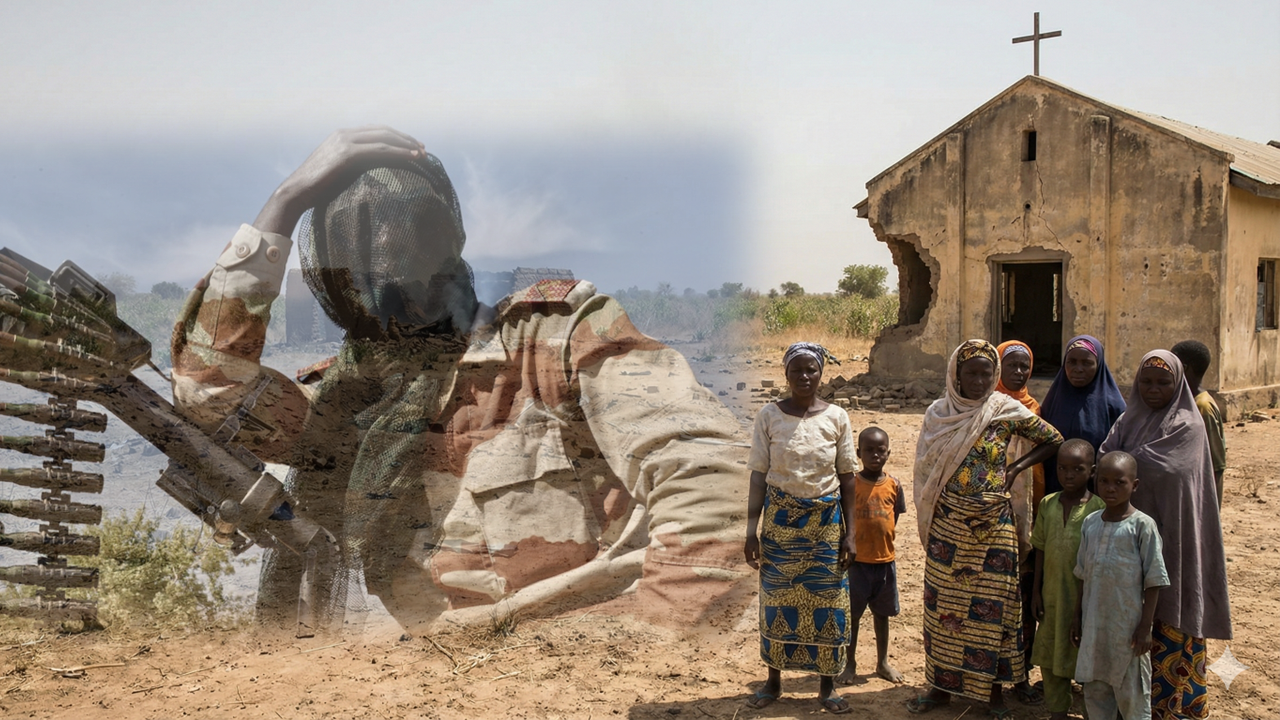

Written by Stefan van der Berg
On December 25, 2025, the sky over Sokoto state in Northwest
Nigeria erupted. The United States, in a rare direct intervention, launched
airstrikes targeting ISIS-affiliated militants (likely the Lakurawa faction).
The operation was swift, kinetic, and explicitly framed by Washington as a
necessary move to stop the "vicious killing of innocent Christians."
For those of us watching from the outside, it feels like a
victory—a "finally" moment where the West steps in to defend the
defenseless. But for the believers on the ground in the Sambisa Forest and the
chaotic borderlands of the North, this intervention may be less of a shield and
more of a target.
The Illusion of the Surgical Strike
The logic behind the strike is standard military doctrine:
degrade the enemy’s infrastructure to reduce their capacity for violence. But
in the context of Nigeria’s insurgency, this logic is flawed. We are not
fighting a standing army with a central command that can be decapitated; we are
fighting a hydra.
Boko Haram and its splinters (ISWAP, Ansaru, and Lakurawa)
are fragmented. They operate out of stolen vehicles, temporary camps, and
motorbikes. They do not rely on the kind of heavy infrastructure that missiles
are designed to destroy.
"Kinetic action against Boko Haram is like trying to
put out a forest fire with a hammer. It smashes the branches, but it spreads
the embers."
When a missile strikes a camp, the fighters disperse, only
to regroup closer to the villages. The infrastructure of terror in Nigeria is
not brick and mortar; it is an ideology that survives the blast.
The Narrative Trap: "Christians vs. Terrorists"
The most dangerous aspect of this strike is not the
explosion, but the explanation. By explicitly framing this operation as a
mission to "protect Christians," the US inadvertently walks into a
trap set by the terrorists themselves.
Boko Haram has long preached that the Nigerian government is
a puppet of the "Christian West." When the US strikes and declares it
is doing so for the Christians, they validate this propaganda. This erases the
complex reality of the conflict. The insurgents operate on a doctrine of
Takfirism, which allows them to kill anyone—including Muslims—who does not
subscribe to their radical worldview.
"Boko Haram kills Muslims for not being Muslim enough,
and Christians for not being Muslim at all. To ignore the former is to
misunderstand the enemy entirely."
If we ignore the fact that thousands of moderate Muslims
have also been slaughtered for rejecting the insurgency, we alienate the very
allies the Church needs to survive. We turn a battle against evil into a battle
between religions, which is exactly what the enemy wants.
The "Lightning Rod" Effect
The strategic fallout of this narrative is terrifyingly
predictable. The insurgents cannot shoot down a US jet. They cannot strike back
at the Pentagon. To regain their "honor" and prove they are not
defeated, they will turn their guns on the only targets they can reach: the
soft, undefended Christian villages in the Middle Belt and the North.
"The US drone flies away after the strike; the
villagers are left behind to face the wrath of an enemy looking for
revenge."
"When Washington frames the conflict as a religious
war, they are not protecting Nigerian Christians; they are painting a target on
their backs."
By trying to be the "protector," the West risks
becoming the "provocateur," transforming local Christians from
neighbors into "proxies" of a foreign power in the eyes of the
extremists.
The Scale of the Suffering
We must not downplay the horror that prompted this strike. Persecution watchdogs report that Nigeria consistently accounts for the vast majority of Christians killed worldwide, with thousands losing their lives each year. Nigeria
currently accounts for nearly 90% of all Christians killed for their faith
worldwide.
These are not just numbers; they are brothers and sisters
who have been massacred in their homes, churches, and farms. The desire to do
something is righteous. But if military strikes only exacerbate the danger, how
do we respond?
A Call to the Church: How We Can truly Help
If missiles are not the answer, what is? We cannot leave
this solely to governments. As the global body of Christ, we are called to a
different kind of intervention—one that strengthens the remnant rather than
just attacking the enemy.
1. Support, Don't Just Defend The Nigerian church is not
asking to be evacuated; they are asking for the strength to remain.
Organizations like Open Doors are on the ground providing trauma counseling for
widows, rebuilding burnt churches, and offering emergency food aid to the
millions displaced in IDP camps. Our financial support should go here—to the
"infrastructure of hope" that keeps the church alive in the
wilderness.
2. Prayer as a Weapon We often treat prayer as the last
resort, but in spiritual warfare, it is the first. We must pray specifically
for the endurance of the saints. Pray that their faith would not fail in the
face of this "lightning rod" backlash. Pray for the confusion of the
enemy’s plans, not just their destruction.
3. Advocacy for the Whole Truth We must advocate for
policies that address the root causes—poverty, lack of education, and
justice—rather than cheering for short-term military spectacles. We must speak
up for the persecuted without falling into the "Crusader" rhetoric
that endangers them further.
The church in Nigeria is bleeding, but it is also standing.
Our role is to hold up their arms, not to cheer for actions that might bring
the roof down on their heads.